
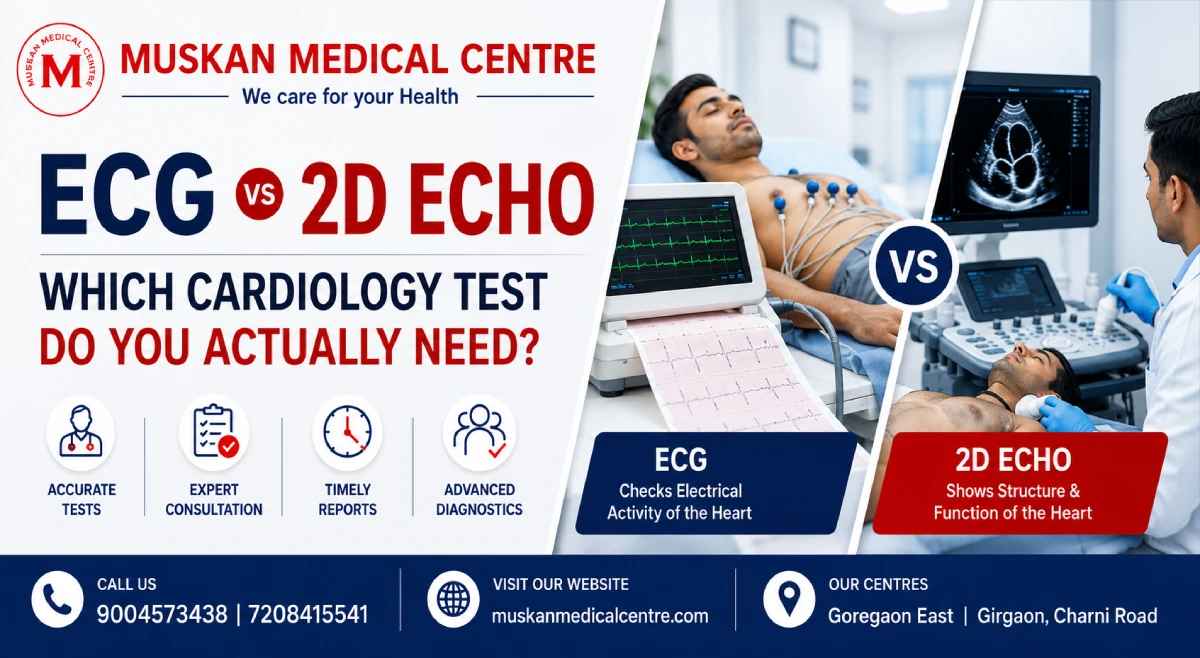
Your doctor mentions you need a cardiac test, and suddenly you’re staring at two unfamiliar terms — ECG and 2D Echo — wondering if they’re the same thing, whether you need both, and why one takes five minutes while the other takes twenty. This confusion is common enough that it’s worth untangling properly, once, so you’re not googling it again the next time it comes up.
Short answer: they test different things. An ECG looks at your heart’s electrical activity. A 2D Echo looks at its physical structure and pumping function. Neither replaces the other, and depending on your symptoms, your doctor might recommend just one, or both together as part of a broader cardiology test in Girgaon Mumbai.
What an ECG Actually Measures
An electrocardiogram, ECG for short, records the electrical signals that trigger each heartbeat. Electrodes placed on your chest, arms, and legs pick up this activity and translate it into the familiar wavy-line printout you’ve probably seen in medical dramas.
What it’s good at catching:
- Irregular heart rhythms, like arrhythmia or atrial fibrillation
- Signs of a previous or ongoing heart attack
- Electrolyte imbalances affecting heart function
- Conduction problems, where electrical signals aren’t travelling through the heart properly
What it doesn’t show: an ECG can’t tell you how well your heart is actually pumping blood, or whether your valves are functioning correctly. It’s a snapshot of electrical timing, not a structural picture. This is one of the more common misunderstandings patients bring to a cardiology test in Girgaon Mumbai, or one booked closer to Goregaon, expecting an ECG to reveal more than it’s actually designed to.
What a 2D Echo Actually Shows
A 2D Echocardiogram uses ultrasound waves to create a real-time, moving image of your heart, essentially the same technology used for pregnancy scans, applied to cardiac imaging instead. A trained technician moves a probe across your chest while the machine builds a picture of your heart’s chambers, valves, and overall pumping motion.
What it’s good at catching:
- Valve abnormalities, whether they’re too tight, too loose, or leaking
- Reduced pumping capacity, often described as ejection fraction
- Structural issues present from birth, or that developed over time
- Fluid buildup around the heart
- Enlarged heart chambers, which can indicate long-term strain
Unlike an ECG, a 2D Echo genuinely shows movement and structure, not just electrical timing. This is often the test that catches issues an ECG alone would miss entirely, which is exactly why doctors sometimes recommend both as part of the same cardiology test in Girgaon Mumbai rather than choosing one over the other.
Why Your Doctor Might Order Both
This is genuinely one of the most common points of confusion we see with a cardiology test in Girgaon Mumbai: patients assuming one test makes the other unnecessary. It’s not redundant to have both tests done, even though they might feel repetitive to a patient unfamiliar with what each one actually checks. Think of it this way: the ECG tells you if the heart’s electrical system is firing correctly, while the 2D Echo tells you if the physical pump itself is working properly. A heart can have a normal ECG and still have a structural problem an Echo would catch, and vice versa.
For patients with chest pain, breathlessness, or a family history of heart disease, a combined cardiology test in Goregaon Mumbai covering both ECG and 2D Echo tends to give doctors a genuinely complete picture rather than half of one.
When Each Test Is Typically Recommended
This is one of the more practical questions patients ask before booking a cardiology test in Girgaon Mumbai: which specific test do I actually need for my situation? ECG alone is often sufficient for:
- Routine screening as part of an annual health checkup
- Investigating palpitations or a racing heartbeat
- Pre-surgical clearance in low-risk patients
- Following up on medication that affects heart rhythm
2D Echo is typically added when:
- A murmur is detected during a physical exam
- Breathlessness or fatigue suggests reduced heart function
- There’s a family history of structural heart disease
- Follow-up is needed after a heart attack or diagnosed heart condition
- Blood pressure has been poorly controlled for an extended period
If you’re unsure which applies to your situation, that’s a completely reasonable thing to ask your doctor directly rather than guessing, since the right combination genuinely depends on your specific symptoms and history. This is exactly the kind of question our team fields regularly when patients come in for a cardiology test in Girgaon Mumbai without a clear referral specifying which test they need. If you’re due for a broader checkup alongside cardiac testing, our Executive Health Package includes both ECG and cardiac risk screening as part of a fuller panel.
What to Expect During Each Test
Patients booking a cardiology test in Goregaon Mumbai often ask how long to budget for the appointment. An ECG takes just a few minutes. You lie down, electrodes are attached, you stay still and breathe normally, and it’s done. No preparation needed, no discomfort beyond a few adhesive patches being removed afterward.
A 2D Echo takes longer, usually twenty to thirty minutes, since the technician needs to capture multiple angles of the heart to get a complete picture. You’ll lie on your side, gel is applied to your chest, and a probe moves across the area while images appear on a screen. It’s painless, though the gel can feel a little cold initially.
Neither test requires fasting, and both are non-invasive — no needles, no radiation exposure with either one. This makes both components of a cardiology test in Girgaon Mumbai fairly low-stress for patients who feel anxious about medical procedures generally.
Understanding Your Results
An ECG report will typically show whether your rhythm is “normal sinus rhythm” or flags a specific abnormality by name, information a doctor needs to interpret in context rather than something to self-diagnose from. This is true regardless of whether you’ve had a cardiology test in Goregaon Mumbai or at our Girgaon branch.
A 2D Echo report often includes a number called ejection fraction, essentially the percentage of blood your heart pumps out with each beat. A normal range typically falls between 55 and 70 percent, though what counts as concerning depends heavily on your overall clinical picture, not just this one number in isolation.
Either way, results from a cardiology test in Girgaon Mumbai, or the Goregaon East branch, should always be reviewed with your doctor, who can interpret findings alongside your symptoms, medical history, and other test results rather than in isolation.
Booking at Muskan Medical Centre
Whether you need an ECG, a 2D Echo, or both as part of a broader cardiology test in Girgaon Mumbai or Goregaon Mumbai, our cardiac team handles this regularly, with reports reviewed carefully rather than just printed and handed over. Both our Girgaon, Charni Road and Goregaon East branches run identical cardiac testing protocols.
Frequently Asked Questions (FAQs)
Q: Do I need to fast before an ECG or 2D Echo?
No, neither test requires fasting. You can eat normally beforehand
Q: Which test is more accurate for detecting heart problems?
They’re not competing tests, they check different things. An ECG assesses electrical activity, while a 2D Echo assesses structure and pumping function. Most complete evaluations use both.
Q: Is a 2D Echo the same as an ultrasound?
Yes, it uses the same ultrasound technology, just applied specifically to imaging the heart.
Q: How often should I get a cardiology test done?
This depends entirely on your risk factors and any existing conditions. Your doctor can recommend an appropriate frequency based on your specific situation.
Q: Can these tests be done through home sample collection?
These are in-centre procedures requiring specialised equipment, so both ECG and 2D Echo need an in-person visit to either branch. Routine blood work related to cardiac risk, like a lipid profile through pathology, can still be arranged via home sample collection beforehand.
Q: I have a normal ECG, do I still need a 2D Echo?
Not necessarily, unless your doctor has specific concerns about structural heart function based on your symptoms or history that an ECG alone wouldn’t reveal.
Book Your Preventive Checkup
Charni Road Branch – Shop No. 1 & 2, Regal House, 92/94 J.S.S. Road, near Girgaon Church, Girgaon, Mumbai – 400004
Phone: +91 72084 15541
Timings: Daily, 8:00 AM to 9:00 PM
Book an appointment: Contact Muskan Medical Centre
Goregaon East Branch – Shop No. 305, 3rd Floor, DGS Sheetal Ekta Society, Opposite Oberoi Mall, Shivdham Complex, BMC Colony, Dindoshi, Goregaon East, Mumbai – 400063
Phone: +91 90045 73438
Working Hours: Daily, 8:00 AM to 9:00 PM
If your doctor’s recommended an ECG, 2D Echo, or both, our team can walk you through what to expect and get you scheduled at whichever branch works best. Book your appointment today or call ahead if you have questions about which test is right for you.