
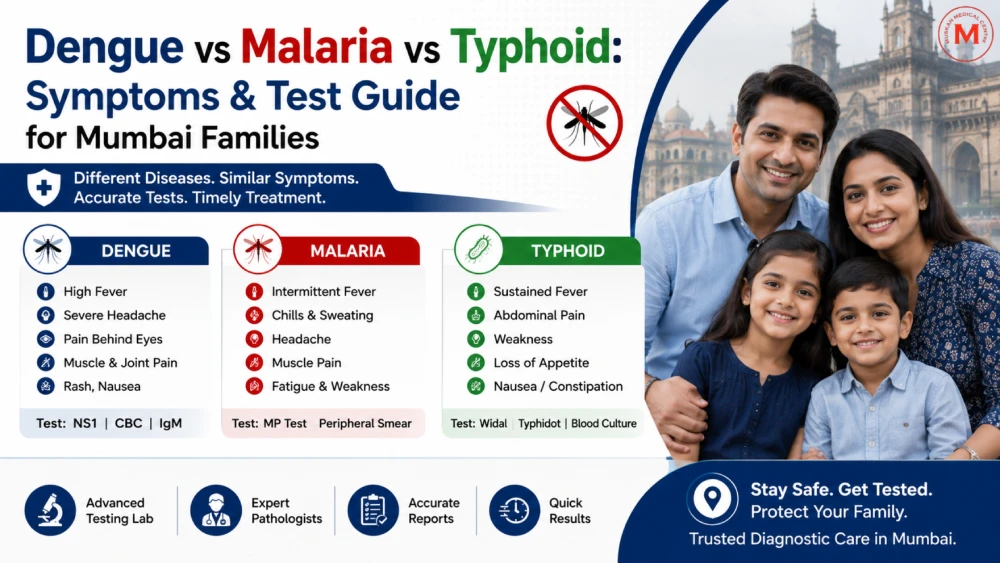
Every monsoon, the same scene repeats itself across Mumbai households. Someone in the family develops a sudden fever, the temperature climbs past 102°F, and within hours everyone is asking the same question: is this just a viral fever, or something more serious?
If you’re searching for a reliable dengue test in Goregaon, Mumbai, you’re probably already dealing with this exact worry. The honest answer is that dengue, malaria, and typhoid all start out looking remarkably similar. A doctor examining a patient on day one often cannot tell them apart just by looking at symptoms. The only way to know for certain is a blood test — and knowing which test to ask for, and when, can save you days of uncertainty.
This guide walks through how these three illnesses differ, what each test actually checks for, and when it’s time to stop waiting and get tested.
Why These Three Fevers Get Confused So Often
Mumbai’s monsoon creates near-perfect conditions for all three illnesses at once. Stagnant water in coolers, terraces, and construction sites breeds the mosquitoes behind dengue and malaria, while heavy rains contaminate water supplies, setting the stage for typhoid. It’s entirely possible for a family to encounter all three risks within the same week without realising it, which is why so many residents look for a same-day dengue test in Girgaon, Charni Road, Mumbai the moment a fever doesn’t break.
What makes early diagnosis tricky is that all three conditions begin with the same basic pattern: fever, body ache, headache, and fatigue. It’s only after a few days, or after a proper blood test, that the differences become clear enough to act on.
Dengue, Malaria, and Typhoid — Side-by-Side Comparison
| Feature | Dengue | Malaria | Typhoid |
| Cause | Aedes mosquito bite | Anopheles mosquito bite | Contaminated food or water |
| Fever pattern | Sudden, high, continuous | Cyclic — chills then sweating | Gradual, rising over days |
| Key symptoms | Headache, eye pain, joint pain, rash | Chills, sweating, nausea | Abdominal pain, weakness |
| Danger sign | Falling platelet count | Confusion, jaundice | Fever beyond a week |
| Confirmatory test | Dengue NS1 or IgM | Malaria smear or antigen test | Blood culture or Widal test |
| Usual test timing | NS1 in first 7 days | Anytime during fever | After 5–7 days of fever |
Dengue: What to Watch For
Dengue often starts deceptively mildly. The first day can feel like an ordinary viral fever — some tiredness, a mild headache, perhaps a low-grade temperature. By the second or third day, things escalate quickly: a high, continuous fever, a headache that feels different and more intense than usual, pain behind the eyes, and aching joints that make simple movements uncomfortable.
The real danger with dengue isn’t the fever itself — it’s what happens to the platelet count as the illness progresses. This is why doctors don’t rely on symptoms alone. A Dengue NS1 antigen test works well in the first week of illness, while an IgM antibody test becomes more reliable if the fever has lasted longer. Alongside this, a CBC (Complete Blood Count) tracks the platelet count, which is what your doctor will watch most closely over the following days. Patients booking a dengue test in Goregaon, Mumbai often ask for this combination upfront to avoid a second visit.
Malaria: The Cyclic Fever
Malaria tends to announce itself differently. Instead of a fever that simply stays high, it often comes in waves — a period of intense shivering and chills, followed by a spike in temperature, followed by heavy sweating as the fever breaks. This cycle can repeat every two to three days depending on the specific parasite involved.
Because different types of malaria parasites require different treatment approaches, a peripheral blood smear examined under a microscope remains the most reliable way to confirm the diagnosis and identify exactly which strain is responsible. Rapid antigen tests are also available when a faster initial result is needed, particularly useful for patients who cannot wait for a lab-based smear result.
Typhoid: The Slow Build-Up
Typhoid behaves differently from the other two. Rather than hitting hard and fast, it tends to build gradually — the fever creeps upward day by day rather than spiking suddenly. Alongside the fever, patients often notice abdominal discomfort, a loss of appetite, and either constipation or loose motions.
Because typhoid is caused by bacteria (Salmonella typhi) rather than a virus or parasite, testing works a little differently. Early on, a Widal test can offer clues, but it’s most accurate after the first week of fever. A blood culture test offers a more definitive answer and is often recommended when typhoid is strongly suspected, especially if fever has persisted despite basic treatment.
When Imaging Is Also Needed
Blood tests confirm which infection is responsible, but in more severe or prolonged cases, your doctor may also recommend an abdominal ultrasound. This is fairly common when dengue causes fluid accumulation around the abdomen, or when typhoid leads to an enlarged liver or spleen. Imaging in these situations helps the treating doctor understand how the illness is progressing internally, beyond what a blood report alone can show.
At Muskan Medical Centre, this kind of imaging is supported by the experience of Dr. Dhananjay Rastogi, a Radiologist with over 27 years of experience in diagnostic imaging. His background in abdominal imaging and preventive screening means that when a fever workup does call for an ultrasound, patients benefit from reporting that is both careful and clinically informed. Combining reliable pathology testing with experienced imaging support gives doctors a fuller picture when a case needs closer monitoring.
When Should You Actually Get Tested?
A simple rule of thumb that most doctors in Mumbai recommend during monsoon: if fever persists beyond 2–3 days, or crosses 103°F, it’s time to stop waiting and get a blood test. Home remedies and rest are appropriate for the first day or two of an ordinary viral fever, but persistent or worsening fever is your body’s signal that something more specific needs to be ruled out.
This becomes even more important for children and elderly family members, whose symptoms can escalate faster and who may not always be able to clearly describe what they’re feeling. This is one of the most common reasons families request an urgent dengue test in Girgaon, Charni Road, Mumbai for an elderly parent rather than waiting it out.
Getting Tested Without the Hassle
At Muskan Medical Centre, we understand that during monsoon season, the last thing a family with a sick member wants to do is step out in the rain to sit in a waiting room. Whether you need a dengue test in Goregaon, Mumbai or a fever panel in Girgaon, Charni Road, Mumbai, our process stays the same: simple, fast, and stress-free. That’s exactly why our home sample collection service exists — a trained technician visits your home, collects the sample safely, and your reports are ready without anyone having to travel while unwell.
For families who prefer visiting in person, our pathology lab at both branches is equipped to run dengue, malaria, and typhoid panels with same-day reporting for most tests, so you’re not left waiting anxiously for answers.
If you’re unsure which test you need, our team can guide you toward the right fever panel or health checkup based on your symptoms — you don’t need to self-diagnose before calling us.
Whether you’re located near our Goregaon East branch or closer to Girgaon and Charni Road, both centres follow the same testing protocols and turnaround times, so you don’t have to compromise on quality no matter which one is more convenient for you. Many patients looking for a dengue test in Goregaon, Mumbai specifically reach out to us during monsoon precisely because same-day dengue and typhoid results let them start treatment without losing a day to uncertainty. Families searching for a dengue test in Girgaon, Charni Road, Mumbai choose us for the same reliability closer to South Mumbai.
Frequently Asked Questions (FAQs)
Q: Can I have dengue and typhoid at the same time?
Yes, co-infections are possible, especially during peak monsoon months. This is one reason doctors often recommend a combined fever panel rather than testing for just one illness in isolation.
Q: How soon after fever starts should I get a dengue test?
A Dengue NS1 test is most accurate within the first 7 days of fever. If more than a week has passed, an IgM antibody test is usually more reliable.
Q: Is a normal viral fever different from these three illnesses?
Yes. Viral fever typically resolves within 3–5 days with rest and fluids. If fever continues beyond that, or keeps climbing, it’s worth ruling out dengue, malaria, or typhoid with a proper test.
Q: Do I need to fast before a dengue or typhoid test?
No fasting is required for a dengue NS1, IgM, or typhoid Widal test. Your doctor will let you know if any other tests ordered alongside require fasting.
Q: Can children get tested at home?
Yes, our home sample collection service is available for patients of all ages, including children, making the process far less stressful than a clinic visit during illness.
Q: How long do reports take?
Most fever panel results, including dengue and typhoid, are available the same day. Malaria smear results are typically ready within a few hours.
Q: Is a dengue test available at both branches?
Yes, a dengue test in Goregaon, Mumbai and a dengue test in Girgaon, Charni Road, Mumbai follow the exact same protocols, so you’ll get equally reliable results at either branch.
Visit Us or Book a Home Collection
📍 Goregaon East Branch – Visit
📞 Call Us: +91-9004573438
📍 Girgaon Charni Road (East) Branch – Visit
📞 Call Us: +91-7208415541
Don’t wait for symptoms to worsen. Book your fever test today or request a home sample collection — our team at Muskan Medical Centre is ready to help you get clear answers, fast.